
Key takeaways:
- ICC research says lawyers need emotional intelligence to understand the “emotional journey” of businesses in disputes
- Cultural awareness is crucial for lawyers to avoid and resolve cross-border disputes
- The study challenges the idea that business is purely rational, highlighting the role of emotions in disputes
- Lawyers who consider emotions and cultural aspects can navigate conflicts more effectively
- ICC promotes ADR mechanisms like arbitration for faster, cheaper dispute resolution compared to court
New research underscores the importance of emotional intelligence and cultural awareness for lawyers specializing in international dispute resolution.
The study, conducted for the International Chamber of Commerce (ICC), Jus Connect, and the McCann Worldgroup, and presented at Paris Arbitration Week’s 8th ICC European Conference on International Arbitration, found that lawyers need to go beyond legal expertise to effectively navigate cross-border conflicts.
The research emphasizes the importance of lawyers understanding the emotional journey of businesses they advise. This understanding, according to the study, is crucial for navigating the emotional complexities that arise during disputes.
Traditionally, people thought business was all about logic and practicality. This new research says emotions actually play a big role in business deals. For example, when companies first start trading internationally, everyone feels excited. But lawyers usually get involved only when things go wrong, so they mostly hear negativity. It’s important to remember though, that most international trade (99%) goes smoothly and never needs a lawyer.
Understanding these emotional dimensions is essential for lawyers to manage disputes effectively and reach fair resolutions, the study suggests.
The study also highlights the importance of understanding different cultures (cultural awareness). Lawyers who are familiar with how people from other countries do business can avoid and fix problems more easily. Interestingly, the research found that most people (77%) prefer to settle disputes by focusing on what each side actually wants (called an “interest-based approach”) rather than just focusing on who’s right or wrong (like going to court) or using tactics to pressure the other side.
The rest of the ICC conference focused on how to become more involved in an interest-based outcome.
A panel moderated by legal correspondent Catherine Baksi discussed the research results. Jean-Remi de Maistre, CEO and co-founder of Jus Mundi, shared the story behind Jus Connect, which was created as a tool to rationalize a difficult choice to be made at times of high emotionality, i.e., the appointment of an arbitrator.
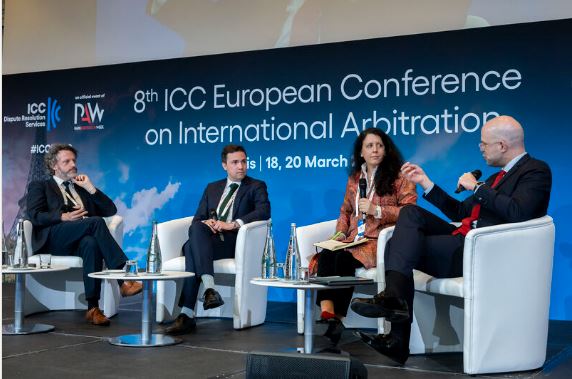
(Photo from Baksi’s Linkedin page)
Since emotions and cultural backgrounds are a big part of business, even something like artificial intelligence (AI) can be biased depending on who creates it. That’s why the panel agreed it’s important to have a variety of people involved in creating things like AI to avoid this bias.
Alexander G. Fessas, secretary general of ICC International Court of Arbitration, stressed that choosing an arbitrator who understands both cultures involved in a dispute is important for a fair hearing.
Fessas also said it’s better to try and fix the business relationship before going to arbitration (like through mediation or negotiation) – even if it means less work for lawyers! In the long run, this approach might actually lead to more businesses using arbitration instead of going to court.
Gideon Wilkins, head of research at McCann Truth Central, mentioned the benefit of general counsels being involved in everyday business decisions, as it helps them understand the company’s needs better when disputes arise.
The ICC, a global business organization, promotes alternative dispute resolution (ADR) mechanisms like arbitration. These mechanisms offer businesses faster, more predictable, and cost-effective ways to resolve disputes compared to lengthy court battles.
The ICC also plays a significant educational role by sharing knowledge and expertise in international arbitration. This educational focus enhances the skills of dispute resolution professionals, ultimately contributing to more effective conflict resolution.
In conclusion, the ICC research highlights the evolving skill set required for successful dispute resolution lawyers in today’s globalized world. By incorporating emotional intelligence, cultural awareness, and the benefits of ADR mechanisms, lawyers can better serve their clients and contribute to a fairer and more efficient dispute resolution process.Ⓒ



 Business Bayani PH
Leave a comment