

Key takeaways:
- World Economic Forum survey reports 56% of chief economists predict a global economic slowdown in 2024, with an increase in geo-economic fragmentation.
- IMF warns that almost 40% of global employment is exposed to AI, potentially deepening inequality and affecting both advanced and developing economies.
- Global economic challenges include tight financial conditions, rapid advances in generative AI, deepening global tensions, and rising inequalities.
- Regional outlook varies, with the Middle East and North Africa facing uncertainty, Europe expecting weakened growth, and Asia-Pacific regions anticipating economic growth.
- Urgent need for global cooperation emphasized by WEF, particularly to address issues such as easing global inflation, stalling growth, and the impact of AI on the labor market.
In a recent survey by the World Economic Forum (WEF), chief economists predict a challenging outlook for the global economy in 2024. A substantial 56% of respondents anticipate a slowdown, accompanied by an escalation in geo-economic fragmentation.
The Chief Economists Outlook highlights persistent challenges stemming from tight financial conditions and the rapid advancement of generative artificial intelligence. Despite 43% of economists foreseeing unchanged or stronger conditions, a notable 70% believe that geo-economic fragmentation will intensify in the coming year.
Saadia Zahidi, managing director at the World Economic Forum, is worried about the unstable economy. The Chief Economists Outlook reveals ongoing challenges, testing the global economy’s strength amid growing differences.
Zahidi stressed the importance of global cooperation, pointing to challenges like easing global inflation, slowing growth, tight finances, deepening tensions, and rising inequalities. She emphasized the need to promote sustainable and inclusive economic growth.
The survey participants, comprising 77% and 70% respectively, anticipate the loosening of labor markets and financial conditions in 2024. However, the report notes a slight weakening of economic growth prospects in the Middle East and North Africa (MENA) region due to uncertainty surrounding the Israel-Hamas war and its broader implications.
While 61% of economists still foresee moderate or stronger growth in MENA during 2024, challenges persist due to weak oil demand and a sharp contraction in tourism. In contrast, 93% of economists expect at least moderate growth in South Asia, and 86% predict upward movement in the East Asia and Pacific region.
The outlook in Europe has significantly weakened since September 2023, with 77% of respondents now expecting weak or very weak growth. Furthermore, 43% of economists predict an economic slowdown in the United States, according to the survey report.
Artificial intelligence (AI) remains a significant factor in economic discussions. Chief economists participating in the survey expect AI-enabled benefits to vary across income groups. Approximately 79% believe generative AI will increase efficiency and innovation in 76% of high-income economies in 2024.
Looking ahead to the next five years, 94% anticipate these productivity benefits becoming economically significant in high-income economies, compared to only 53% for low-income economies.
However, the rise of AI also brings concerns, with almost 40% of jobs globally expected to be affected, according to the International Monetary Fund (IMF).
IMF chief Kristalina Georgieva emphasized the need for governments to establish social safety nets and retraining programs to counter the impact of AI. In a blog post on January 14, Georgieva stated, “We are on the brink of a technological revolution that could jumpstart productivity, boost global growth, and raise incomes around the world. Yet it could also replace jobs and deepen inequality.”
The IMF analysis highlights that almost 40% of global employment is exposed to AI, with both advanced and developing economies facing challenges and opportunities. In advanced economies, about 60% of jobs may be impacted by AI, while in emerging markets and low-income countries, AI exposure is expected to be 40% and 26%, respectively.
AI’s impact on the global job market may lead to income disparities. Workers adept with AI might see improved productivity and higher wages. Yet, there’s a risk of increased inequality, especially in countries without the infrastructure or skilled workforce to capitalize on AI advantages.
To tackle these issues, the IMF stresses creating thorough safety nets and training programs. This makes the AI shift more inclusive, safeguarding jobs and reducing inequality.
As the world enters the AI era, the IMF encourages policy makers to act swiftly. The IMF has developed an AI Preparedness Index, measuring readiness in areas such as digital infrastructure, human capital, innovation, and regulation. Wealthier economies, including Singapore, the United States, and Denmark, tend to be better equipped for AI adoption.
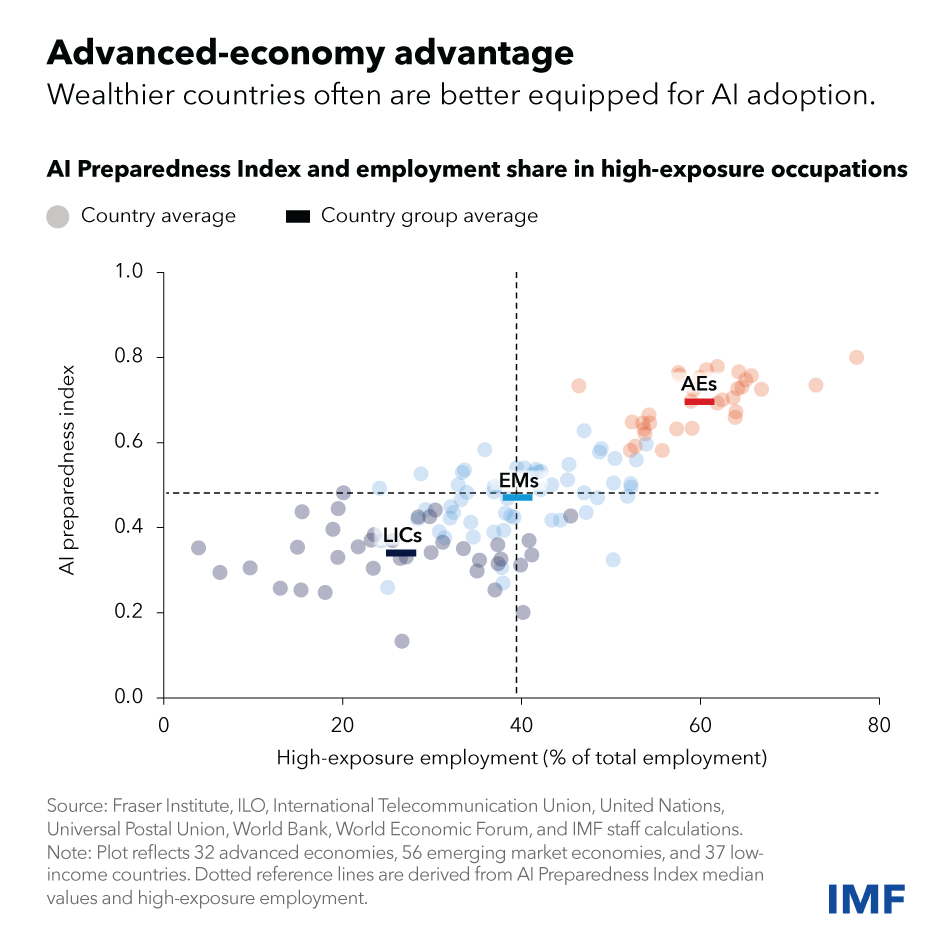
The IMF recommends developed nations prioritize AI innovation, integrate it with strong regulations. Emerging markets should focus on building a foundation with investments in digital infrastructure and a skilled workforce.
In conclusion, the WEF survey and IMF analysis underscore the complexities and challenges ahead for the global economy in 2024. The rise of AI, while promising increased productivity, also brings the need for proactive measures to ensure an inclusive and prosperous future for all.◼



 Business Bayani PH
Leave a comment