

Key takeaways:
- At the start of his term, President Marcos, Jr. appointed himself as agriculture secretary, emphasizing the need for the moral persuasion of a President to address the sector’s complexities.
- Data comparison reveals that the Agriculture, Fisheries, and Forestry (AFF) sector’s performance under Marcos was notably lower than that of his three immediate predecessors.
- The growth rates in the AFF sector during Marcos’ tenure were below the targets set by the Philippine Development Plan (PDP) 2023-2028, challenging his claims of success.
- Labor productivity in agriculture met the PDP target during Marcos’ term, but the growth rate of AFF exports contracted by a significant 12.5%, falling far short of the PDP’s annual increase goal.
- Real-world impacts, including sugar, onion, and rice crises, as well as unfulfilled promises like reducing rice prices to P20 per kilo, underscore the tangible challenges during Marcos’ leadership as agriculture secretary.
In a previous statement, President Ferdinand Marcos, Jr. defended his decision to appoint himself as agriculture secretary, citing the complexity of the sector and the need for the moral persuasion of a President. However, when examining the data, it becomes evident that his performance in the role does not align with his claims of success.
Marcos said during a press briefing: “I truly believe and I think I was proven right that there are many things that only a President could do and the problems were so important and were so deep that I felt that the authority… I suppose the moral persuasion of a President was necessary for us to be able to figure out, and it really was, agriculture is a much much more complicated thing than most people understand.”
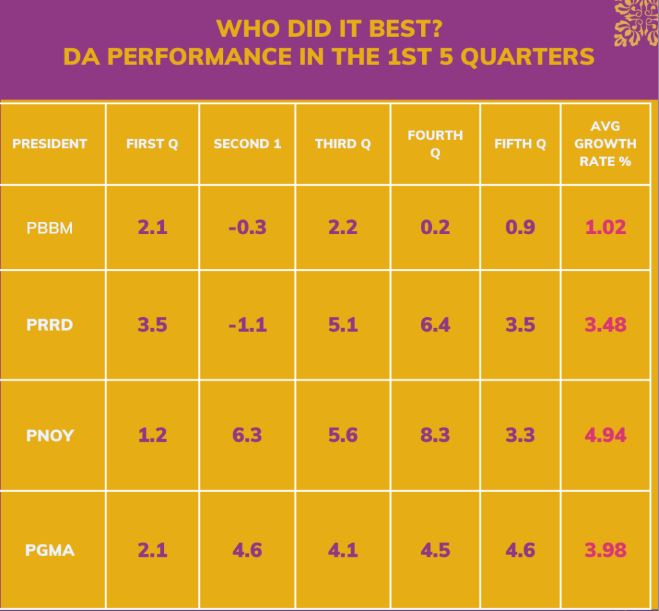
Comparing the growth rates (%) in the Agriculture, Fisheries, and Forestry (AFF) sector during the first five quarters of Marcos II’s tenure with three immediate past predecessors—Duterte, Aquino, and Arroyo— Winnie Monsod, economist and former cabinet member during the Cory Aquino administration, reveals a concerning trend in her blog.
The data indicates that under Marcos’ leadership, the AFF sector’s performance was significantly lower than that of his predecessors who opted to appoint other individuals to the post.
While it is not asserted that Marcos’ predecessors were exceptional, the growth rates in the AFF sector during their tenures were markedly better than his. The evidence challenges Marcos’ assertion of success during his time as Agriculture Secretary.
Turning attention to the Philippine Development Plan (PDP) 2023-2028, which Marcos frequently references in his desire for a transformative and digitized agriculture sector, Monsod found the actual performance falls short of the plan’s targets.
The PDP sets a growth target for the AFF sector between 1.3% and 3.3% annually. Marcos’ average growth rate during his five quarters in office was only 1.02%, below the lower end of the PDP’s target range.
Labor productivity in agriculture, another key metric, grew by 2.5% during Marcos’ tenure, meeting the PDP target but at its lower end. However, Monsod wrote in her blog that the real concern arises when examining the growth rate of AFF exports, a crucial component of the plan.
Labor productivity in economics means how much output or work can be produced by one worker in a given amount of time. It is a key metric because it helps us understand how efficiently workers are contributing to the overall production of goods and services.
High labor productivity often indicates a more effective use of resources, leading to economic growth and higher living standards. It is a crucial measure for businesses and policymakers to assess the efficiency and effectiveness of the workforce in an economy.
Contrary to the PDP’s goal of a 6.4% annual increase, AFF exports during Marcos’ tenure actually contracted by a disheartening 12.5%.
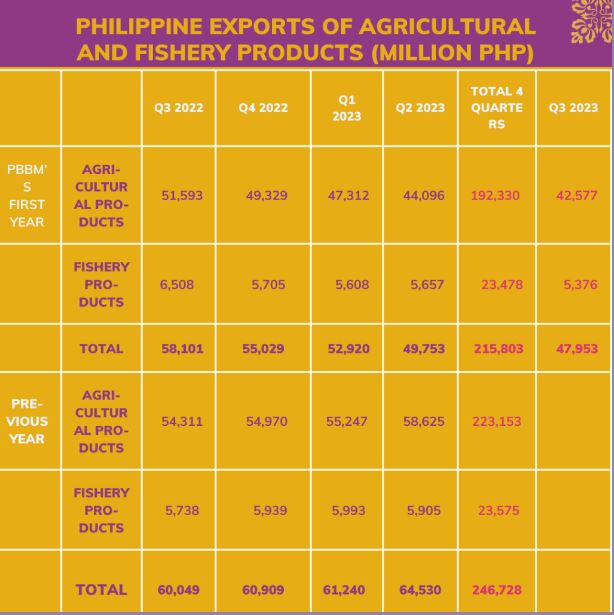
This substantial decline in export value is a cause for concern and raises questions about the effectiveness of Marcos’ strategies in promoting and expanding agricultural exports, Monsod wrote. Notably, the negative trend persisted into his fifth quarter, with agriculture exports continuously falling, in stark contrast to the previous year’s increasing trend.
It is essential to acknowledge that the Department of Trade & Industry plays a role in these export figures. However, the data emphasizes a clear disparity between the PDP targets and the actual outcomes during Marcos’ term as agriculture secretary.
In addition to these economic indicators, it is crucial to consider the real-world impacts of Marcos’ tenure. Instances such as the sugar, onion, and rice crises during his leadership, and their subsequent effect on food prices, cannot be ignored. Furthermore, Marcos’ unfulfilled promise of reducing rice prices to P20 per kilo remains a point of contention.
In conclusion, the data analysis sheds light on President Marcos’ performance as agriculture secretary, revealing a concerning disparity between his claims of success and the actual outcomes.
The AFF sector’s growth rates, labor productivity, and export values all fall short of targets set by the Philippine Development Plan, prompting a critical evaluation of the effectiveness of Marcos’ strategies in addressing the complexities of the agriculture sector.◼
(Tables come from Winnie Monsod’s blog)



 Business Bayani PH
Leave a comment