
From keeping an eye on keystrokes and taking screenshots to recording audio and tracking GPS locations, it’s expected that by 2025, around seven out of ten American companies will be closely monitoring their employees to gauge how productive they are.
This information comes from a study conducted by the United Kingdom-based online resume builder StandoutCV. They aimed to compare the post-pandemic monitoring trends of 2023 with data from 2021.
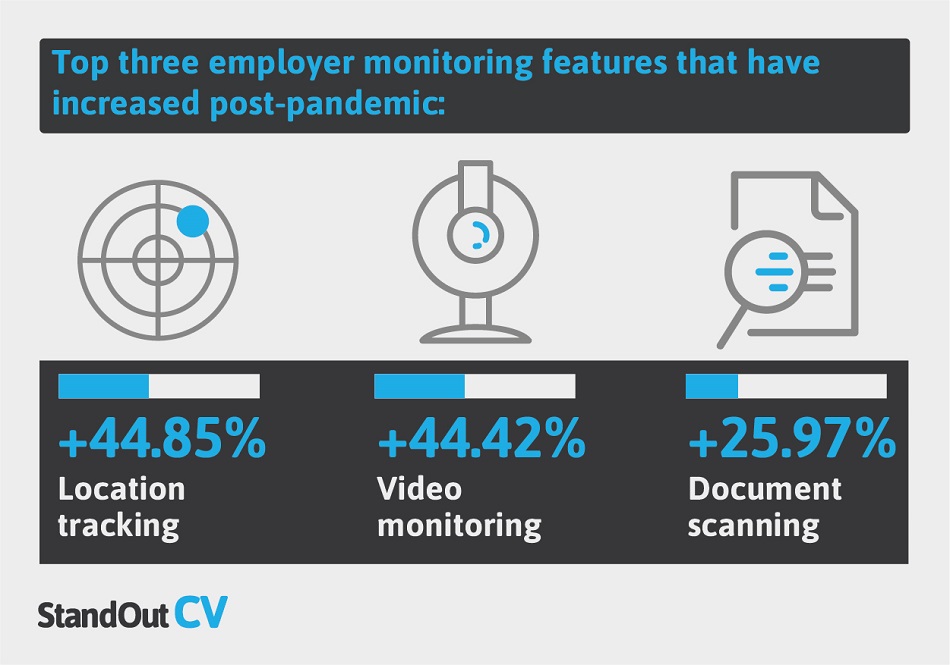
According to the study, “one in three employers now has the tools to track their employees’ exact locations, which is a 44.85% increase in the last two years,” explained Andrew Fennell, Director at StandOut CV.
When looking at the top fifty monitoring tools from both years, the study found that nearly 25% of these tools now have more intrusive features compared to 2021.
Fennell pointed out that these tools have become more sophisticated since the early days of the COVID-19 pandemic, when remote work was less common. For example, screenshots can now be taken randomly, at specific times, or when certain actions occur, like visiting an entertainment website.
Among the most popular surveillance features used by employers are:
- Time tracking (96%)
- Taking screenshots of an employee’s computer screen (78%)
- Video monitoring (42%)
- Keylogging (40%)
- GPS location tracking (34%)
- Recording audio through an employee’s device’s microphone (8%)
What’s concerning is that 38% of these tools operate in stealth mode without the employees’ knowledge or explicit consent. Furthermore, over 80% of employees are monitored in real-time.
Fennell emphasized the privacy implications, saying, “Employees’ private conversations could be recorded in their homes without their consent or knowledge.”
While the use of stealth mode has decreased slightly since 2023, 78% of these “productivity” tools rely on employer-defined conditions. This means monitoring settings can vary for each employee and department or change unexpectedly, potentially leading to workplace discrimination, retaliation, and suppression of union activities.
Fennell advised employees to check their company’s employee handbook for information on monitoring policies to understand what is being collected. He also recommended separating work and personal devices to maintain privacy.
Employee monitoring has become a hot topic, not only in the United States but worldwide. StandoutCV identified Teramind, Verioto Vision, Clever Control, and SentryPC as the top half of the ten most intrusive monitoring programs used in multiple countries.
Advocates argue that these invasive monitoring tools can breach worker privacy, affect their mental and physical health, and potentially harm their safety.
The White House Initiative
Recently, the White House launched a public survey initiative to gauge American workers’ feelings about employer monitoring practices and assess the “serious risks” involved.
The initiative aims to understand the impact of automated tracking tools, which have become more common due to the rise of remote work during the COVID-19 pandemic.
This effort, announced by the White House Office of Science and Technology Policy (OSTP), seeks public input to inform new policies and promote best practices among employers, worker organizations, technology vendors, developers, and civil society.
The survey also solicits feedback on how employers implement monitoring technology and how software vendors develop it. To date, OSTP has yet to release a report regarding its findings.
The OSTP referenced a 2022 investigation by The New York Times, which found that over two-thirds of the largest private employers in the U.S. track individual workers to assess productivity.
Critics argue that automated technology can infringe on worker privacy, impact their health and safety, hinder union activities, and enable discrimination.
The OSTP highlighted various professions and industries where tracking tools are used, including:
- Lawyers with webcams monitoring screen focus
- Nurses wearing RFID badges for location tracking
- Delivery drivers monitored for speed and location
- Call center workers assessed for emotional customer interactions
- Office workers’ keystrokes, chat history, and emails monitored by software on company computers
- Warehouse packers’ work pace tracked by scanners
According to the OSTP, “monitoring conversations can deter workers from exercising their rights to organize and collectively bargain with their employers,” and it can lead to differential treatment or discrimination when combined with employment decisions regarding pay, discipline, and promotion.”
Key findings of the StandOutCV study:
- By 2025, around 70% of big companies will watch what their employees are up to.
- Video snooping is getting super popular, up by 42.42% since 2021 (from 21.88% to 38%).
- A whopping 78% of so-called “productivity” tools take sneaky screenshots of what employees do on their computers, but only when the boss says so.
- The most invasive tool, Teramind, goes all out, reporting keystrokes, taking screenshots, and hiding in stealth mode.
- Some sneaky tools (38% of them) use stealth mode to stay hidden from employees, but that’s down by 23.37% from 2021.
- About 34% of these tools can now track your exact GPS location, which has shot up by 44.85% since 2021—maybe because some folks are secretly working from different places.
- Surprisingly, 8% of these tools can eavesdrop on your conversations using your device’s microphone.
- Overall, employee monitoring tools have become about 24.24% more invasive since 2021.
In the Philippines, when your work involves using a computer provided by your employer, they might keep an eye on what you're doing.

But don't worry, you’re good as long as they follow the rules set by the Data Privacy Act (i.e., the processing falls under any of the criteria for lawful processing under Sections 12 and/or 13). They also have to tell you they're watching.

Also, your boss can't make you stay on a video call all day or work overtime with the camera on. There are better ways to make sure everyone is doing their job without invading your privacy.

If you're working from home, your employer should make sure you have the right computer equipment and support. They should also have rules in place to protect your data and privacy.


 Business Bayani PH
Leave a comment